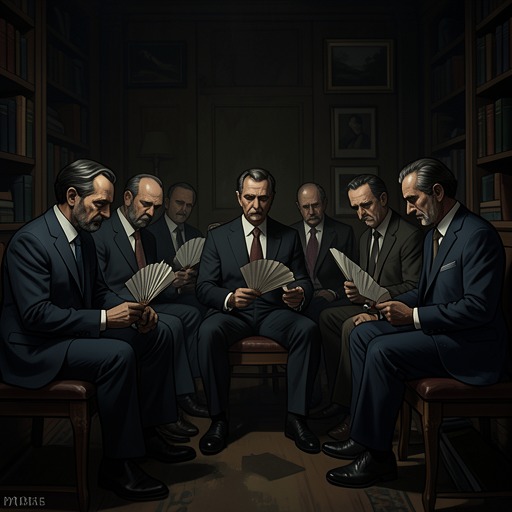
British secret intelligence service
The Seven Dials MysteryThe British secret intelligence service is presented both as a powerful professional institution and as an initially imperfect explanation for the hidden work surrounding Gerald Wade. The investigation’s eventual emphasis is less on a conventional agency hierarchy than on the dangerous collaboration between professionals and amateurs: a network of young people whose willingness to act filled a gap where established investigators had failed.
The service as a clue
Wade’s position at the British Foreign Office and his apparent ability to pass as an amiable fool prompt the suspicion that his public manner conceals a more serious role. An investigator reasons that he may have been highly placed in the British secret intelligence service, an interpretation that would explain why he seemed unlike the ornamental young men around him. His fluent German, described as native-like, lends weight to the possibility of abilities not apparent in his social persona. At this point, however, the theory is a deduction rather than a confirmed account of his official status; it enlarges the suspected Seven Dials affair from ordinary crime into international espionage.
Professional authority and amateur initiative
The service’s professional world is distinguished from the amateurs’ informal methods. When Bundle asks whether Scotland Yard maintains lists of London secret societies, Superintendent Battle answers cautiously that it tries to keep them current. He later urges her to leave the investigation to professionals, but Bundle counters that an amateur has one advantage: she can work in the dark. Their exchange frames secrecy not only as the adversary’s protection but also as an opening for investigators whose position does not make them conspicuous.
The final explanation clarifies the limits of the amateur enterprise. Gerald Wade first approached Battle with the proposal to form a band of amateur workers for secret-service work. Battle warned that it could be dangerous and made participation conditional on accepting that danger; Wade’s friends joined nonetheless. Battle later describes the band as having done work for his Department that nobody else could have done. The account therefore connects amateur initiative to professional authority without claiming that the young agents were themselves a regular unit of the British secret intelligence service.
Mission, danger, and the Seven Dials case
The group’s purpose was to find a particularly dangerous criminal operating in Wade’s world, not merely to investigate ordinary theft. Valuable secret inventions had already been stolen twice, apparently by someone with inside knowledge; professional investigators had tried and failed before the amateurs took up the pursuit. The threat is international in scale, and the plans discussed by the Seven Dials Society confirm that its members are dealing with a consequential invention and a larger scheme.
The danger is explicit. At a secret meeting, the organization’s members acknowledge that too much is becoming known about them and say that people who suspect them must be silenced. The recovered letter from Gerald Wade, found by Lady Eileen Brent and said to mention the organization, makes the danger immediate: it exposes a connection the conspirators would prefer to suppress. The planned inquest into Ronald Devereux’s death is also accompanied by a deliberately circulated account of local youths practising with rifles, an effort to shape how the death will be understood rather than disclose the truth.
Institutional meaning
Battle’s closing account replaces the image of a remote, all-powerful secret agency with a more contingent arrangement: professionals provide warning, direction, and a point of contact, while volunteers accept risks formal investigators could not overcome alone. He presents their motives as both a taste for danger and an honest wish to serve their country. That distinction matters to the novel’s treatment of intelligence work. The British secret intelligence service suggests reach and expertise, but the case is resolved through cooperation across institutional boundaries, and through people whose amateur status lets them move where official knowledge has reached its limit.